Curious Instances
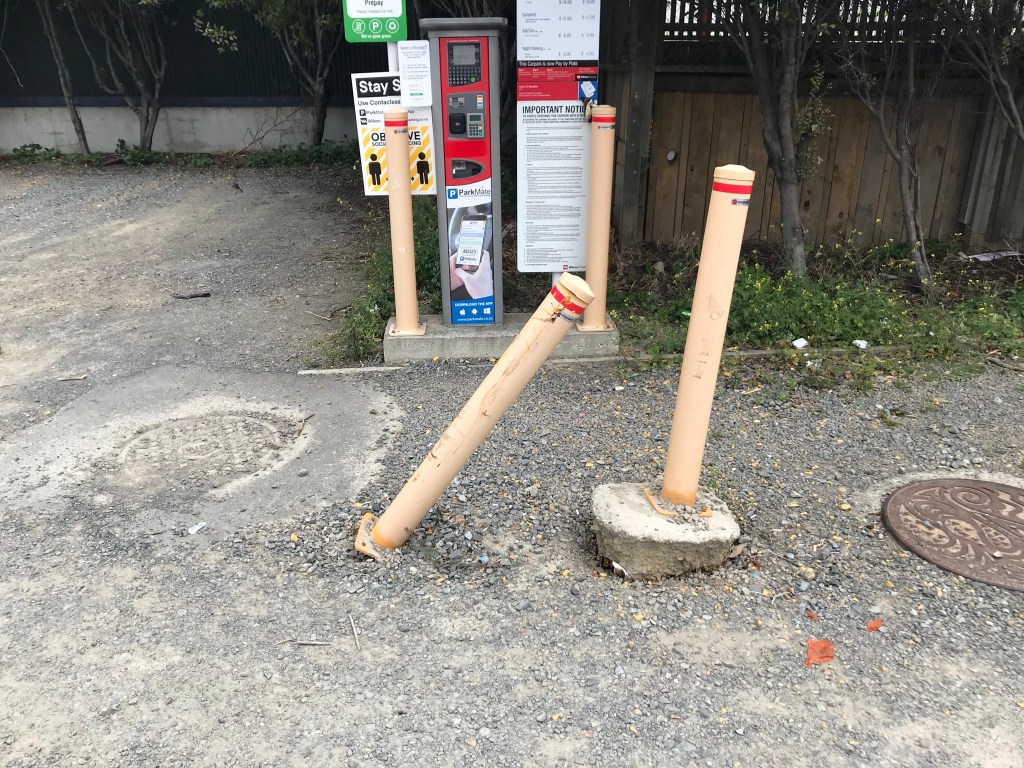
Pole – This poles position is supposed to be upright, but does it still work for its intended use? Did it work on its intended use, hence its position?
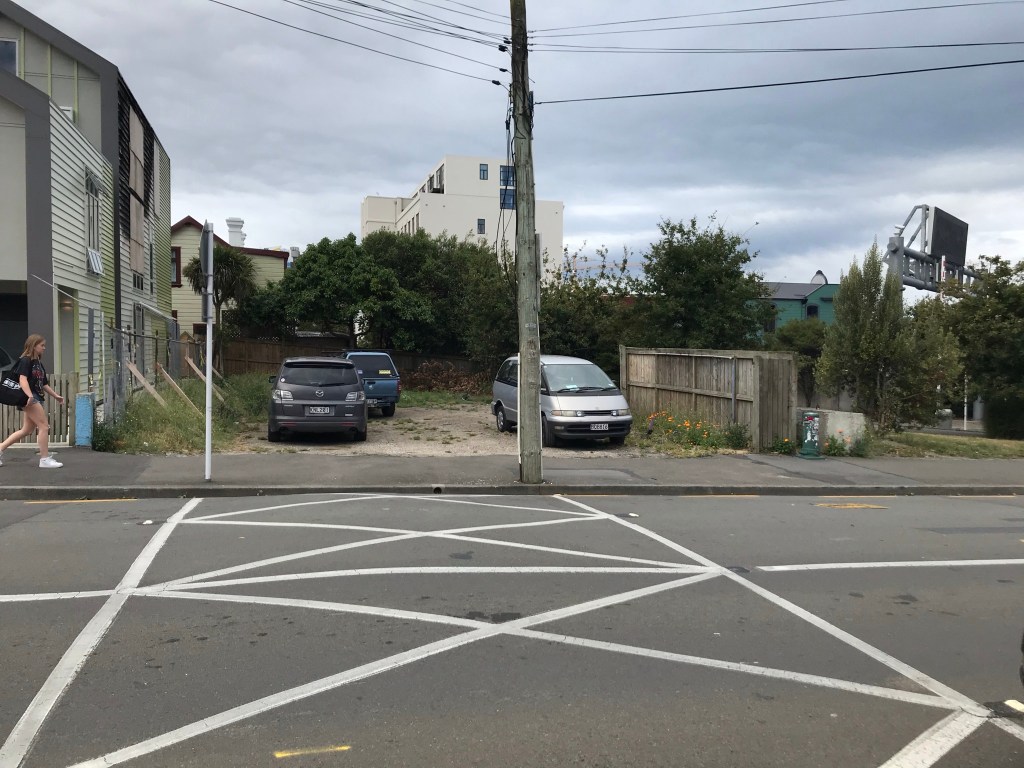
Carpark on empty lot – This is the site of a house that burnt down last year that was incredibly important to the activist scene. It was quickly left by the police as a cause undetermined, and then was slated for demolition. It now sits as a car park, as many abandoned lots in the city do, without any indication of redevelopment.
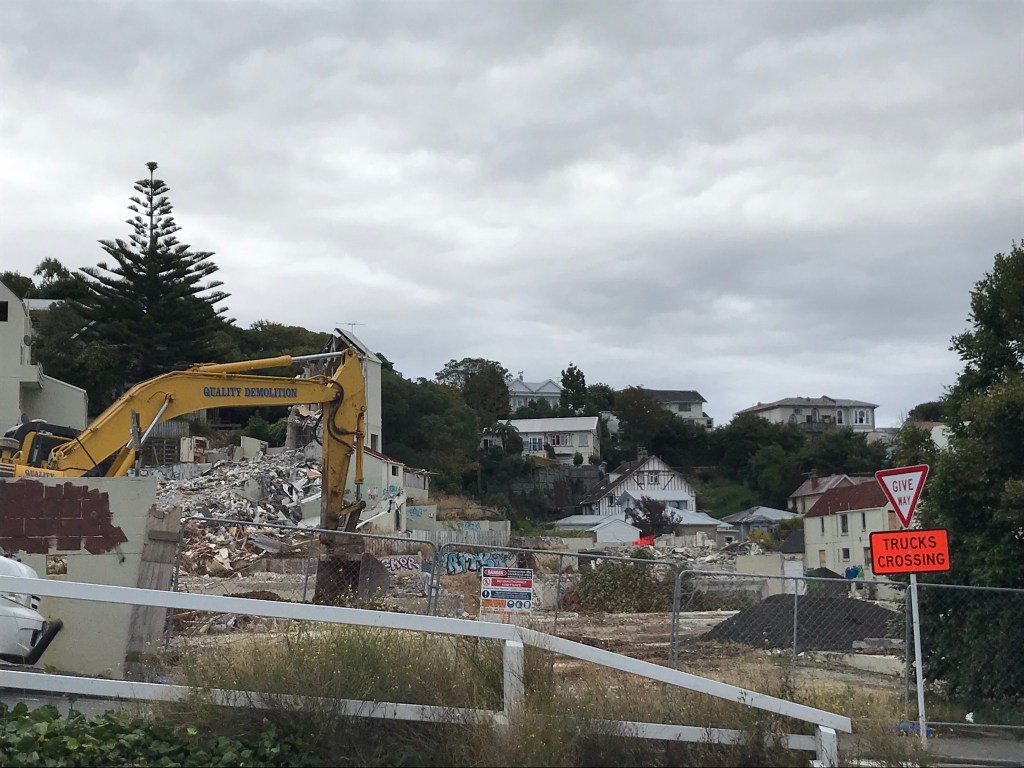
Arlington Demolition – This is a site of a large social housing project currently being demolished for new houses to be built by the council, like the new development opposite this. While providing more adequate housing for people is admirable, at what cost? Where they sufficiently rehoused? And will there by less or more places to live once finished?
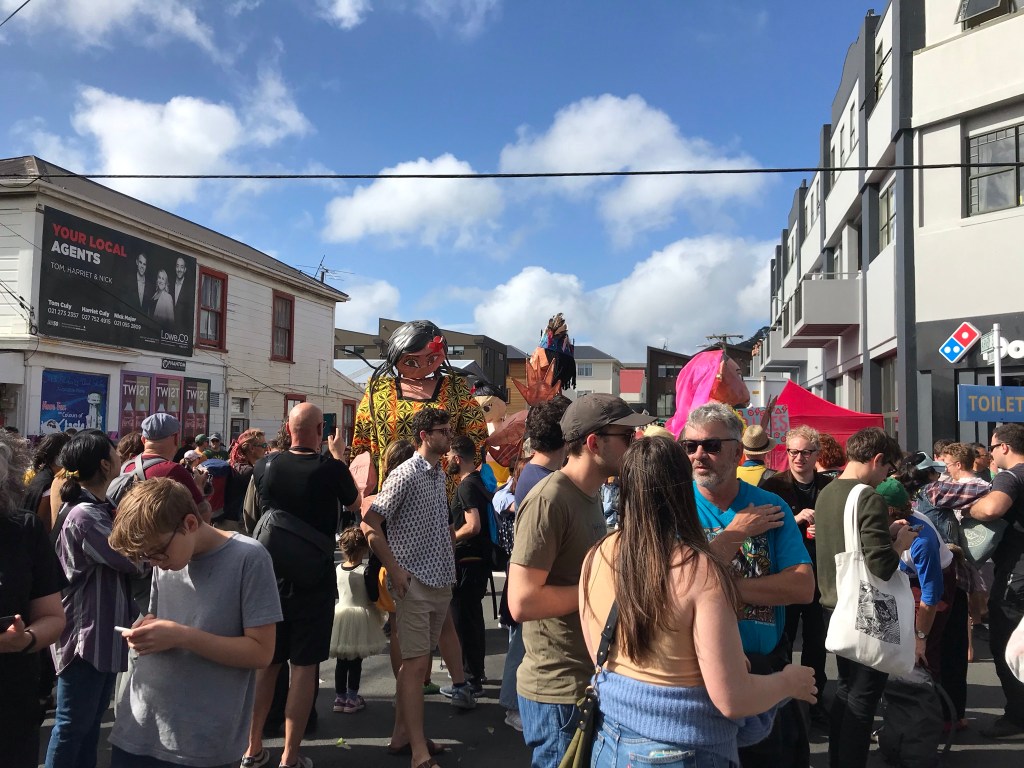
Newtown Street Festival – the Newtown high street closed to traffic and pedestrianised for one day. Why can’t it be like this everyday (people seem to like it)?
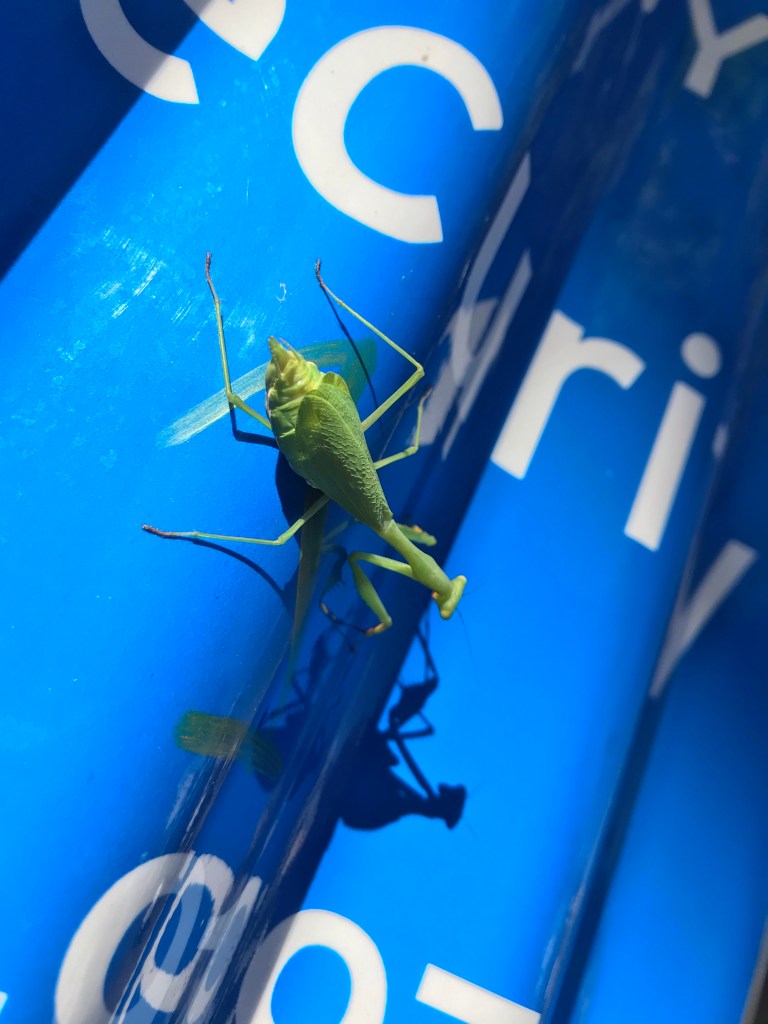
NATURE! – Even though we try our best, other organisms continue to live/if not thrive within the relatively new urban environment. IF they are going to stick around, might as well design with not just humans in mind?
My video highlights how every walk I take currently in which I leave the house is an accessible to someone that cannot easily walk up, and down steps principally, but also takes notes of harsh curbs that cannot be avoided, uneven sidewalk, and steep grades. The whole environment of my pedestrian access is incredibly inaccessible, and there is no effort to make it more so. It takes away a part of the city from people with motor disability.
Addendum: Walking issues around Wellington discussion. It was collectively decided its not great. Even when there is no steps, it is still often hard to climb. And people with non-visible disability are left to the wayside. There is a sensation of exclusion, such as with sensory issues (public spaces can be too noisy etc.). What about those that are marginalised, how do we feel safe in space? Would I feel safer walking somewhere quiet at night than in a crowd like Courtney Place?
Judith Butler & Sunaura Taylor
The relationships and intersections of Disability and Gender.
The talk between Sunaura Taylor and Judith Butler touches upon elements of the political action of being visibly disabled in social spaces, and how we can approach thinking about disability as a physical embodiment of difference in the same way gender can also.
Disability does not inherently have to be a journey of pain and suffering, often the discomfort a person feels will come from how other perceive and react to the way someone behaves in space. This is Dysphoric in the same way people feel with gender when they are not treated as how they feel they should be in public. We often talk about it as in internal struggle of self when in fact it as an external force impacting upon is.
The political action of forcing radical acceptance of the self in society is a powerful one, by allowing things such as unnatural movements (picking up a coffee cup with the mouth), one can be liberated from the strain of dependence forced upon us by the design of certain environments.
This also feeds into a conversation about how social design is currently set up with a model of independence in mind, from individualism pervading every facet of society. We are not individual creatures, and are interdependent, so why do we not act like it? It reinforces hierarchies of people, in which we leave some to fall through the cracks because they do not fit a model that is so narrowly defined/designed.
Tikanga
Urban design is the concept of how and who we make our public space for. This considers architecture, spatial planning, art, and even graphic design. By thinking about how we relate to space, allows us to create a reflection of our own values and beliefs.
As a result, Tikanga should be taken into account within our social spaces. To both reflect our treaty partnership, and bicultural status AND take concepts from Maōridom that can enhance urban space.
The author of this article Rameka Alexander also believes in these principles. From the urbanisation of Maori in the 20th Century and celebrating treaty partnerships, just two small reasons why urban spaces should reflect the people who live there. Creating social space for those to practice Tikanga, brings communities closer together, especially across cultural divides. Visible diversity is the first step to acceptance and true bicultural approaches.
“It is our point of difference in the world. It says: were different, were unique, were beautiful and stand alone”.
Tikanga Maori by Hirini Moko Mead
What is tikanga Maōri? It is often described as ‘the way’, a set of practices and customs that are practiced and could in a very loose sense be translated to tradition and etiquette. There is a whole theorisation of correctness ‘tika’ that surrounds tikanga, whether an act fits in the larger belief and social systems of Te Ao Maōri.
It’s a way of living that has/is a conversation between Maori through time, considered ‘historical precedents’ that are continually validated by each new generation. Mead writes that this wealth of knowledge should be drawn upon as tools to modulate our behaviour, and through understanding tikanga it gives those not of Te Ao Maori to have an entrance to the wider Maori culture and language.
Tikanga applies to my life most often in my work. I am part of the royal commission response to historic abuse in state care, which has a principal task of understanding the extent to/how Maori were abused in care. Knowing tikanga allows us to read between the lines of text written 60 years ago about something considered inane but violated Tikanga. There is a understanding that degrading and lacking culture separates people from their diaspora, and can have lifelong effects. IT is useful in making, as everyday we stand upon Whenua, we are a part of Aotearoa and should take on board such concepts as treaty partners. It provides a way for more voices to be heard, increase diverse thought.
Big Life Fix
The focus of the Big Life Fix was on iterative design processes using feedback and consultation to bring their clients into the design.
Research/brief/consult
Check what is already out there, no point in reinventing the same wheel, or use a foundation to jump off. Important to take an interdisciplinary approach, most things need more than one angle of attack.
There is a Person-centred focus to all the design approaches. Lots of interaction between maker and person in need. This allows to problem solve instead of designing a perceived problem.
End Result aesthetic considerations – can we not have both?
Am highly aware of the medium we are being shown this work – it is highly controlled (and veers on engaging in toxic positivity) – makes it look like this solves all their problems in life.
Do we solve problems or create more ones?
These projects took the experiences of their clients into consideration in order to produce work that was individually tailored to their needs. In a lot of ways, these designers were trying to create something to make up for the fact that the world is not currently designed for people to live in with these conditions. Such as James, Cameras are not designed with mobility issues in mind. We tend to design to middle of the bell curve. For these projects, the designers were successful, as much as they could be with the resources and time, I assume they were working with. They created products that could work for these specific cases, and as a result make a precedent for further work. I believe the creator had a lot of control over the final product, even with the input from the client, they still provide the final piece to the client for them to accept. I enjoy how much input was given to the client and taken onboard. In an ideal world, the client in such a specified case should sit alongside the whole process. Collaboration often provides the most interesting results.
Kumototo Stream Discussion
Confrontation of art in public space is important, everything is political, even that which chooses to no be on the surface confrontational. Who is the art catering to? Who are you communicating with?
A Personal relationship to the space is important to the ethos of making.
Emalani Case (pacific studies) most eloquently summed up my thoughts on making within the public space, and the result of works such as Kedron Parkers. Work creates a connection and grounds us within our environment.
“If you walk in the city,” she said, “work in the city, live in the city, drive in the city, are currently in the city, then you’ve probably walked on (or have been walking on) water. The place we now call Wellington was once (and still is) a place of water, of life-giving streams, each with a name and each with a story.”
Mark Amery “Walking on Water through the streets as wellingtons hidden art revealed” Stuff, updated Jan 14, 202, https://www.stuff.co.nz/entertainment/arts/300202708/walking-on-water-through-the-streets-as-wellingtons-hidden-art-revealed
Artefact
Worldviews presented:
Archaeology vs tea o whenua/tipuna
Artefact vs. taonga
Taonga in museums that were possessed without blessing of the mana whenua. Still held in museums despite grievance
Oral vs material/written knowledge
The people could whakapapa to their ancestors, had the knowledge of how far back the generations were without needing scientific ratings of materials.
Ideas on navigation
The top-down standard mapping from Europeans vs. the person-centred navigation technique of pacific peoples.
“Both are valid forms of navigation if they get you to the same place” – lisa reihana, in pursuit of venus, video, 2015
How was knowledge shared?
Oral tradition – navigation was handed down to navigators by elder generations, trips taken to visit some of the last surviving pacific navigators to learn their ways and continue the knowledge.
Written tradition – How European’s interacted with the pacific for the longest time was through diary writings of explorers. The belief of the European people are placed upon the pacific peoples, creating a distinction between European knowledge and pasifika knowledge of peoples.
Material Culture – Material culture from indigenous colonised cultures are transposed into coloniser environments such as museums to be viewed as curiosities, divorced from their context.
Where and why were these world views constructed? There is a clear through line of white supremacy through most of our knowledge – from how we perceive and as a result treat/talk about others. The words may change but the systems that create and force these relationships remains pervasive.
What knowledge do you hold just because someone told you?
Parent-child relationships
People that we place trust in
Mass tradition
Teachers/sports/music
When told something in confidence?
Trans community oratory history
Lynne Kelly Article
Memory of Place
Memory loci theory – leave a room and forget what you were doing\
Embodied knowledge – knowledge through action, stuff ‘the body knows’
Visual balance, sewing, drawing, musical instruments, singing
Reflexive knowledge – Walking, language
Richard Sennet Article
Key questions raised by the article:
Who owns the dissemination of knowledge?
How is power related to the pervasiveness of worldviews?
Discussion about how modes of production devalue craftsmanship
The questions posed are almost rhetorical, those that have power result in having a disproportionate ability to disseminate what is known. From Noam Chomsky’s concept of manufacturing consent for Countries to ‘legitimise’ agendas, down to keeping certain events secret to the peoples that are directly affected (https://en.wikipedia.org/wiki/Windscale_fire). This is coupled with Marxist viewpoints about commodification of products leads to a race to the bottom, where both labourer and consumer lose out on quality.
What is knowledge do I hold, what is some specialist knowledge I know- when is it right to share that information?
I can share something like I lived in Korea, that is safe and not likely to cause harm to anyone by divulging that information. This is juxtaposed with my specialist knowledge about children abuse in care, which is confidential as to protect identities and privacy of individuals. I should never divulge that information outside of specific members of my organisation. Especially without the consent of people that are in many cases still alive.
CONTEXT MATTERS
Situations and culture. Specifically in terms of culture pertaining to this course’s focus. Knowledge withheld from people is often with some justification, and it is an individual understanding that determines whether that justification is enough. This is muddied by power, there is a perception that those in power know best, and withholding information is based on preformed hierarchies. In most cases I find on a case-by-case basis, my justification for sharing knowledge is based on the amount of harm to the people I am sharing the information will cause. Ideally all information should be available for the individual to make their own judgment on the situation.
Rev. Maōri Marsden excerpt
Kaitiakitanga- guardianship – in most cases of the environment. With the understanding that the world of man and nature are one in concept.
In relationship to the RMA act
Article 2 of the treaty – protect culture and way of life
Fundamental knowledge – oral tradition employs carefully constructed fables/stories/myths around which to assimilate a wealth of information and worldview. This differs from the western scientific viewpoint, we all have a basis from which we work off to create a worldview.
The other part of the excerpt brings us back to who should hold knowledge. Here it brings up an important fact of a lot of western knowledge tradition is noticeably short sighted and lacks a holistic view of the knowledge being shared. A classic example as described in the text is off the atom bomb, we created a way to destroy but no way to mend, clean up the results when we use it.
I can think of a current example where the Kaitiakitanga of an area has come under threat is at Pūtiki Kaitiaki on Waiheke Island where consent was granted to extend upon a marina that would disrupt or destroy much of the areas traditional kaimoana sources, particularly mussels. This is on top of it being a harbour for little blue penguins. As a result there has been a concerted protection campaign to stop development proceeding to protect the kororā. Ana rea that has been looked after since pre colonisation is now under threat due to resource consent granted for the large boat owners to moor, further increasing the rate of inequality and gentrification of waiheke , while it will provide a slight increase in tourism from boat owners – it does not take into account the long term ecological effects to the islands inhabitants in order for business owners to get a few extra dollars in revenue.
Josephine Franks ”Rush to protect penguins at Waiheke’s Kennedy Point as developers move in“ updated April 12,2021, https://www.stuff.co.nz/national/124809764/rush-to-protect-penguins-at-waihekes-kennedy-point-as-developers-move-in
Organise Aotearoa, 2021 https://organiseaotearoa.nz/
Response to Provocation
The Treaty of Waitangi (1987), Dame Claudia Orange says of the history leading up to the signing of the Treaty, 1830-1840: “No longer were they [British government] considering a Māori New Zealand in which a place had to be found for British intruders, but a settler New Zealand in which a place had to be found for the Māori.”
As makers, can we assume to be working in a negotiated cultural space? Is this notion of ‘negotiation’ the same for Māori and non-Māori?
I believe our space has been negotiated in so far as to allow the propagation of the settler-colonial agenda, and only done so out of the minor inconvenience that people happened to already be living on land that resources were to be extracted from. The treaty in its many ways of being held as one of the few indigenous-colonial treaties in the world, was just a pretence for this legalisation of the extraction of resources. Māori have been negotiating just for the right to survive and exist as they wish within a system that does not wish them to do so. This is evident in the way treaty partnerships are held today. There is much more emphasis on the duty of the crown to come to the table and provide than their Maori counterparts, because of this historical imbalance is also a current one. We operate under a western justice system, so the crown negotiates within a system of its own creation. I feel that only now are we just beginning to see movements to truly create bicultural spaces, as evidenced by the uncomfortable Pakeha in the boardrooms having to speak affirmations before their meetings, unsure of this new cultural framework. I am one, not proud of my lack of knowledge in Te Reo and unsure of pronunciation half the time. While on the other hand Te Ao Māori must learn English to operate in this world, not the other way around. Without continuing to push and force this bicultural diversity, we cannot get to the point where we can truly begin negotiating on a level field, without the power imbalance, or difference in cultural understanding.
Professor Margaret Mutu Lecture
The key point of the lecture is the need for a new constitution which removes New Zealand from its colonial basis and into a future in which all peoples are fairly treated considering previous declarations, treaties, and rights of peoples. This is rooted in rights to self-determination which have been evolving since Woodrow Wilson’s 13 points giving peoples right to self-determination after WW1 up until the UN declaration in 2007. Our current System is rooted in racism and a callous disregard of the land and people who inhabit it. It is so pervasive that even the Tribunal, which is one of the most ambitious attempts at redress and reconciliation, no longer takes historic claims as a way of it ‘clearing’ grievance from history by the crown. The Settlements and continued management of Aotearoa is rooted in mercantilism and capitalism, there is a clear pursuit of power and economic gain without considering kawanagatanga and kaitaitanga. This is not only detrimental to the mana whenua but all of us that are part of Aotearoa. Rangitratanga should be a concept held at the heart of every person in this country, we are the sovereign chiefs and should act like it, take care of all. Decolonialisation can only truly be achieved as a republic with a new constitution.
Kaupapa and Ethics
Kaupapa Maori is the principles that govern the worldview of Maori, can be loosely considered as ethical guidelines. Grounded in Tikanga. It emphasises the use of reciprocal relationships and awareness of power dynamics at play. There is general hospitality and kindness that must be given to those hosting and being received. Treat with dignity, love, and humility. A basic and human empathy will build trust and create engagement with the communities and people you deal with
(Whanaungatanga, Manaakitnga, Aroha, Mahaki, Mana, Titiro, whakarongo, korero, kia tupato, he kanohi kitea)
This feeds into universal ethical principles, the guidelines under which research is done on a global level. It follows the same principles of empathy and harm reduction. The western terms of justice come up, which talks about the concept of fairness – in this case how much harm and benefit is being given. It is often up to a higher ethics body to grant a work, and thus they are the jury of justice. Unlike Kaupapa which is can have a more communal application of ethical principles. One has a legalistic bent, and the other is more of the direction to take in everyday life.
Summary of my critical
The work I have done so far is create a strong idea with an embodied sense of performance/story.
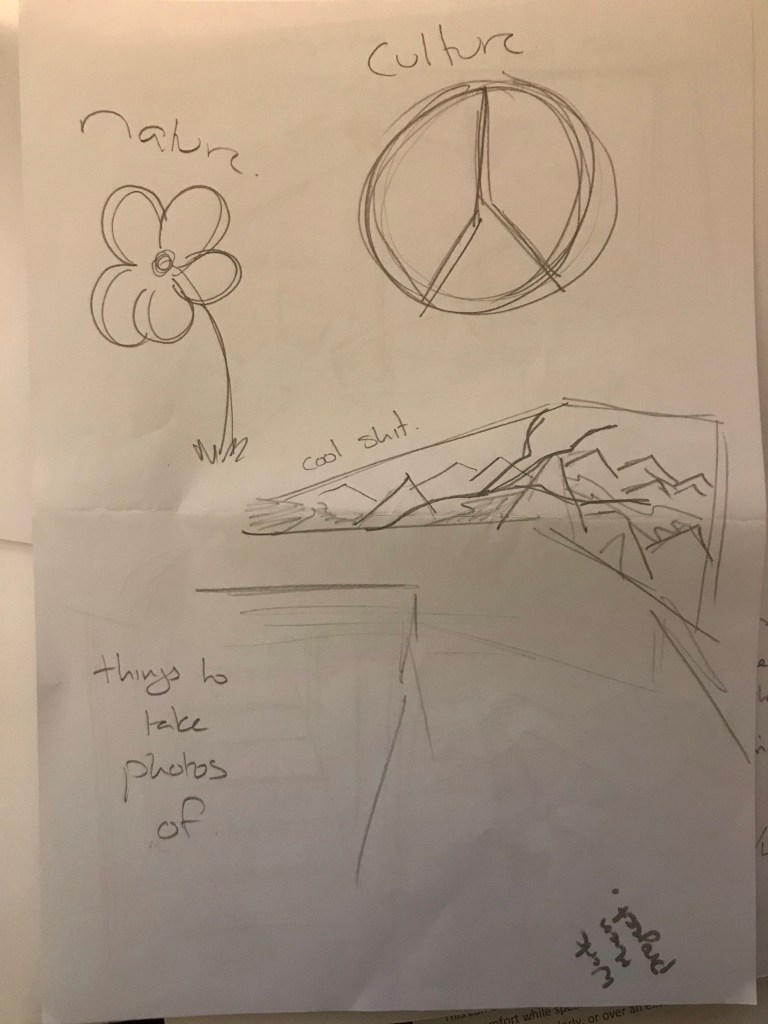
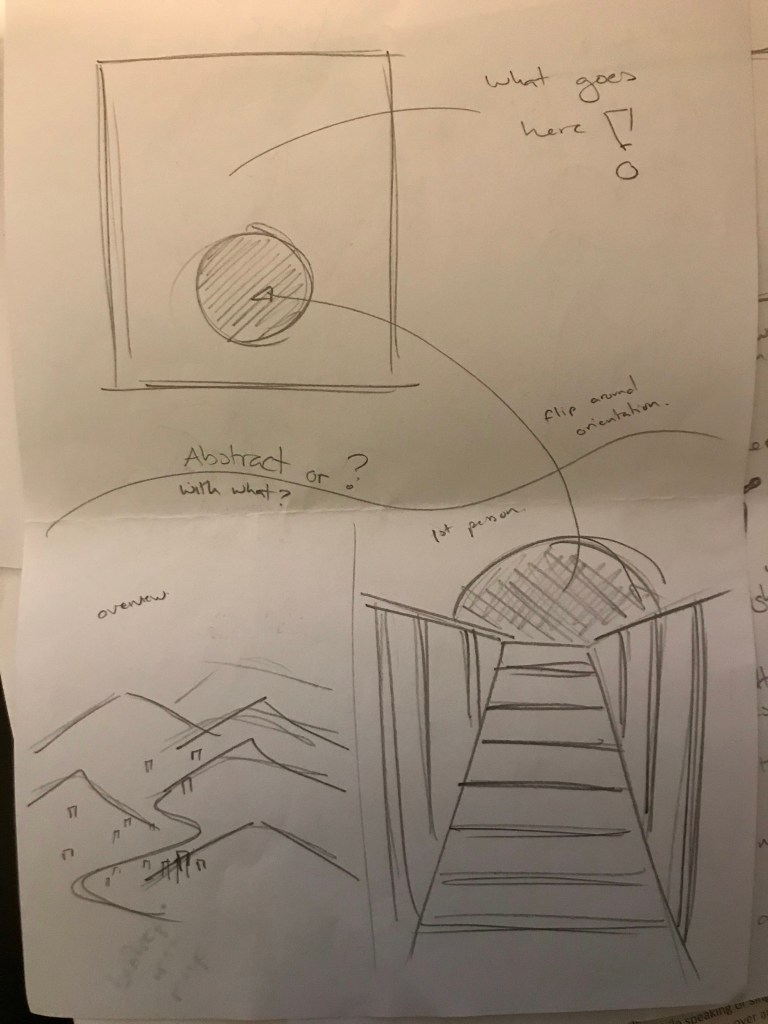
The feedback I received from peers reflected this, they thought it was a strong and clear idea into the accessibility of pedestrian accessways. I just need to continue the process of making, firstly see if the structure I want to create can support itself. Then once that is sorted figure out the content I want to display in the structure. This will involve doing multiple trips with my camera, taking interesting things that catch my eye. Keeping in mind the format size of the work
IO need to start doing more surrounding work into larger cultural reference on these topics of accessibility. Especially safety in low light spaces. Also look into the laws behind residential private property and what public spaces should achieve. So far a lot of my thinking about the work has been personal/interpersonal experiences i have had, and want to expand to encompass more views. Especially more local viewpoints in the disability/mobility space.
Now that I have my idea, i would like to stop having such a broad focus on the space – and begin work more specifically on the issues I am wishing to discuss and raise.
FINAL PROJECT
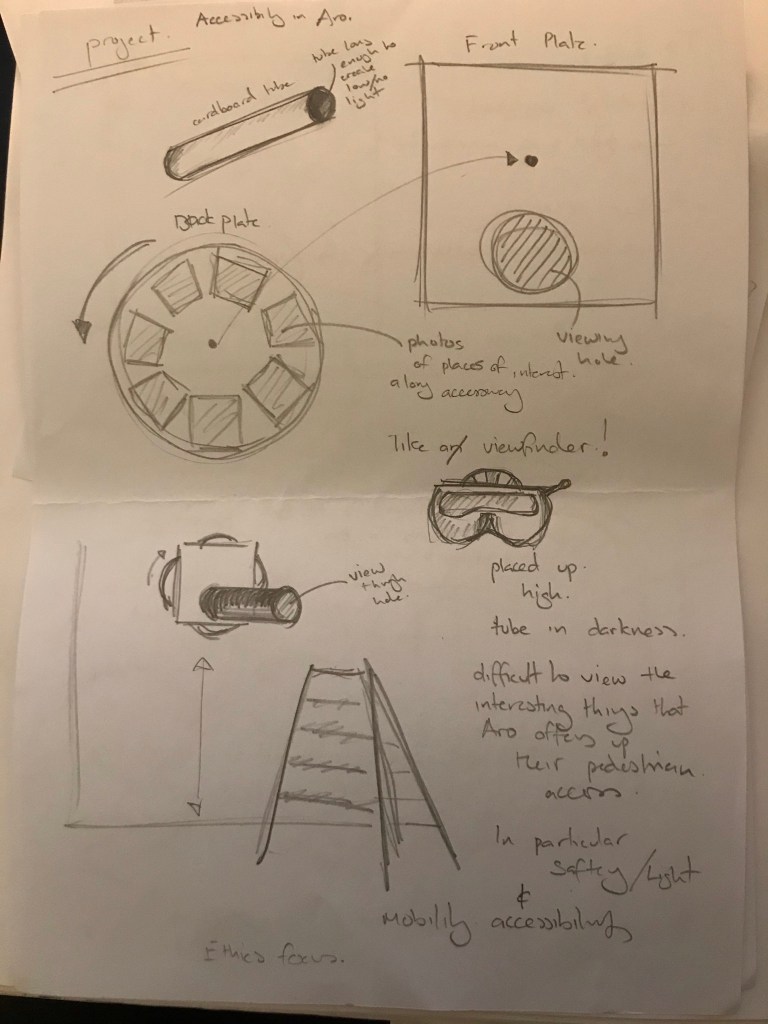
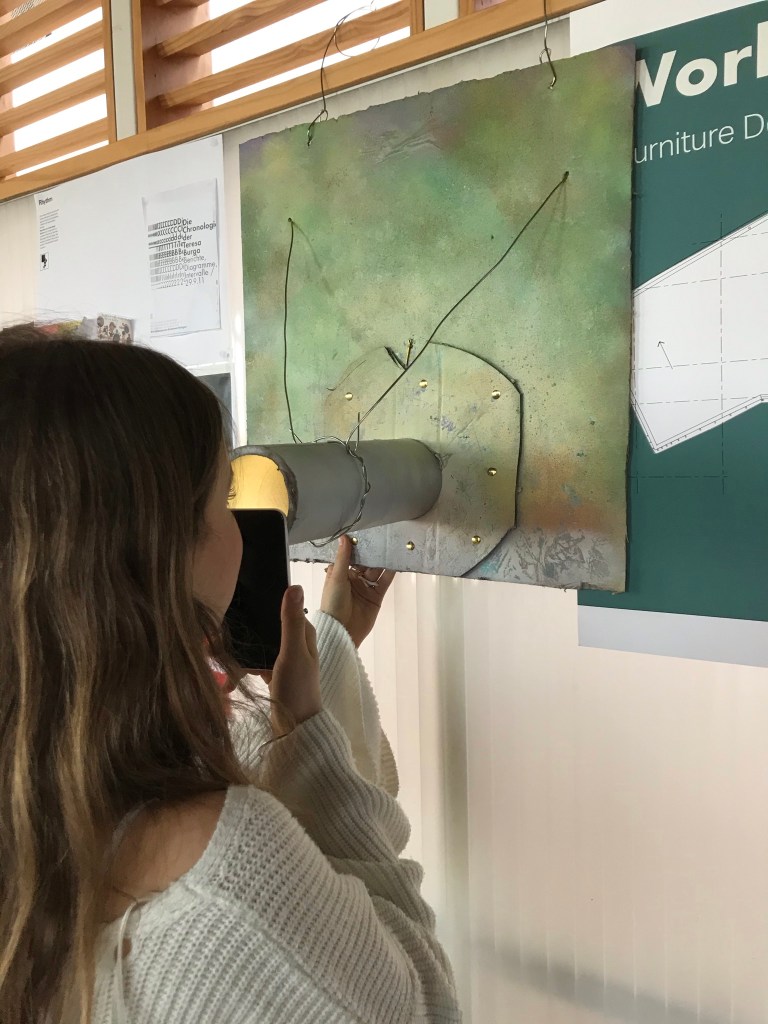
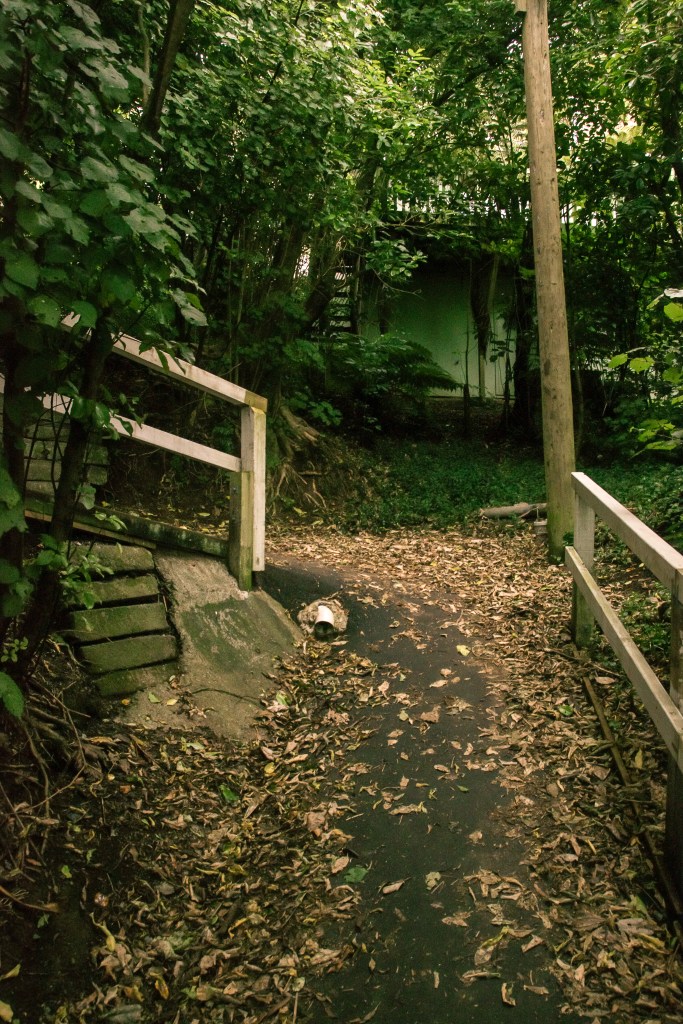
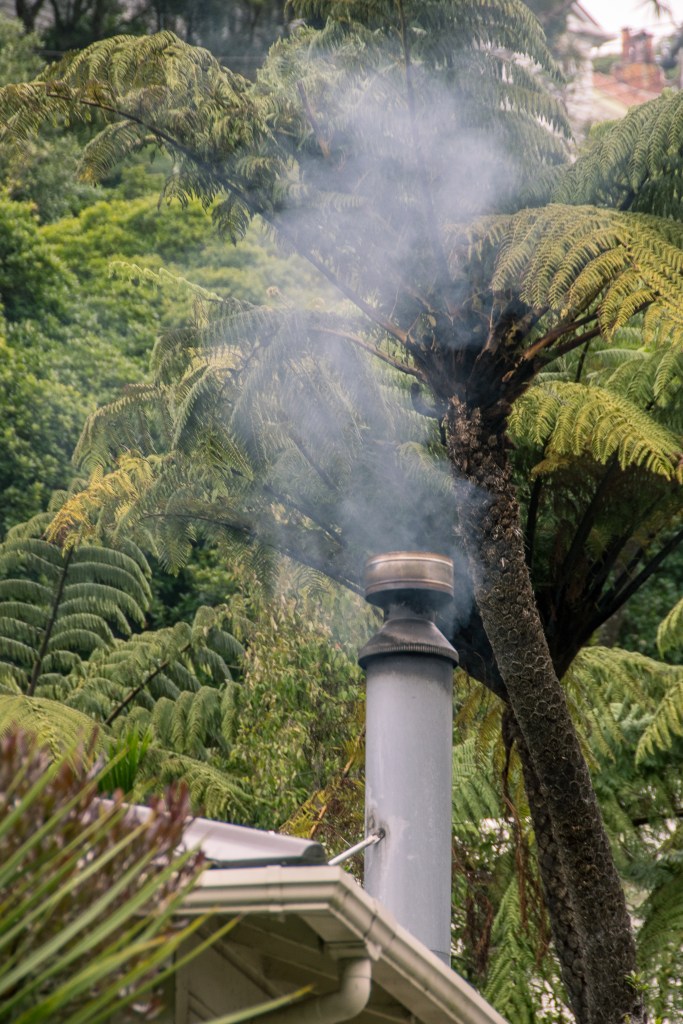
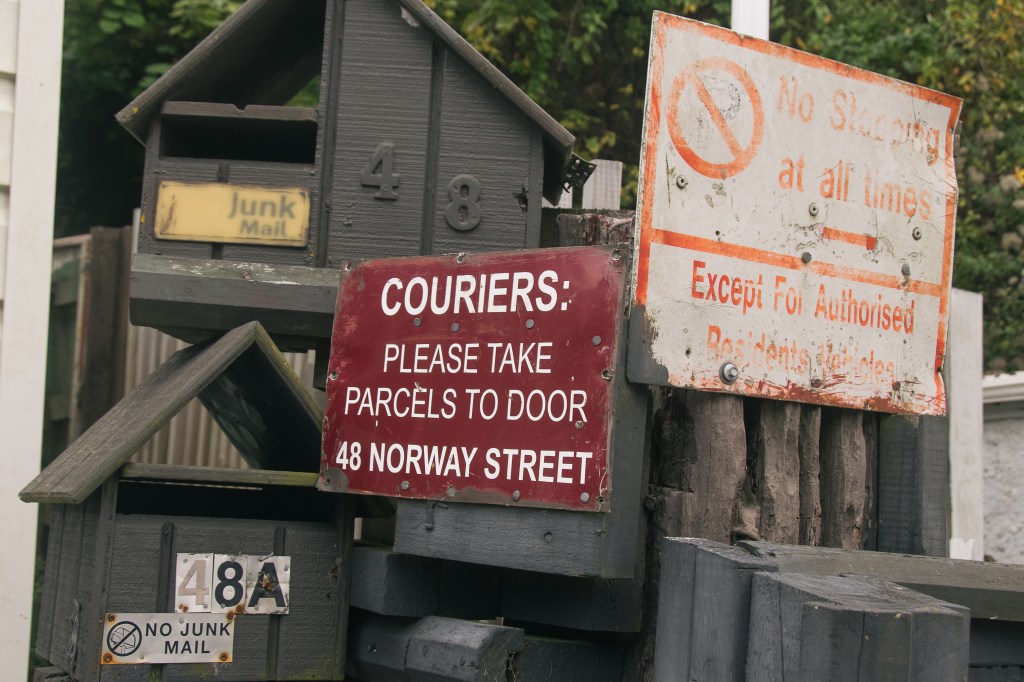
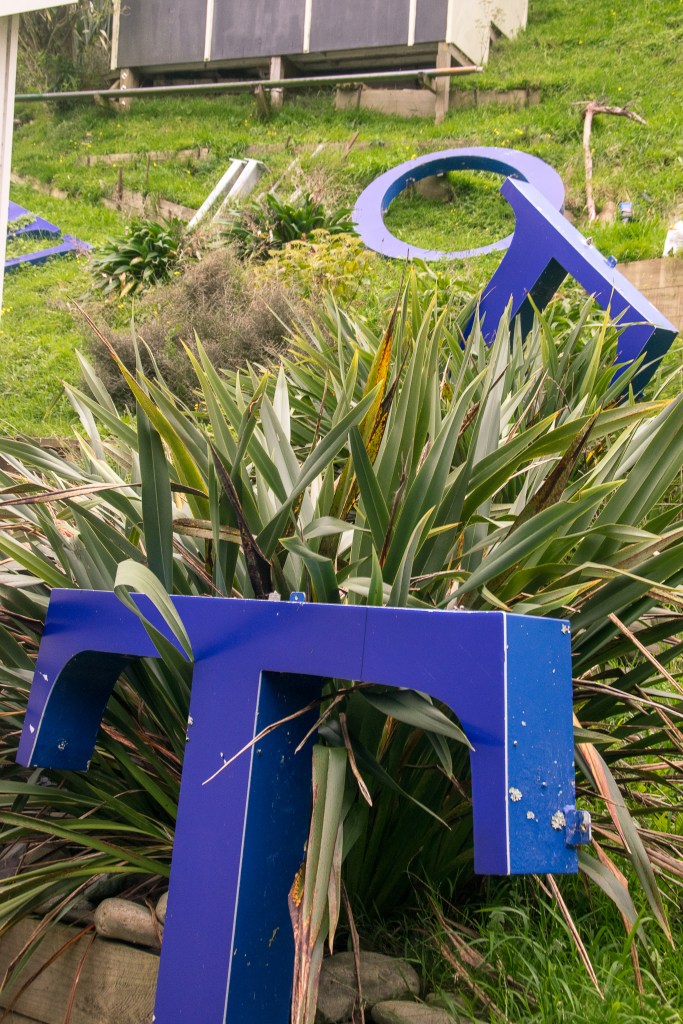
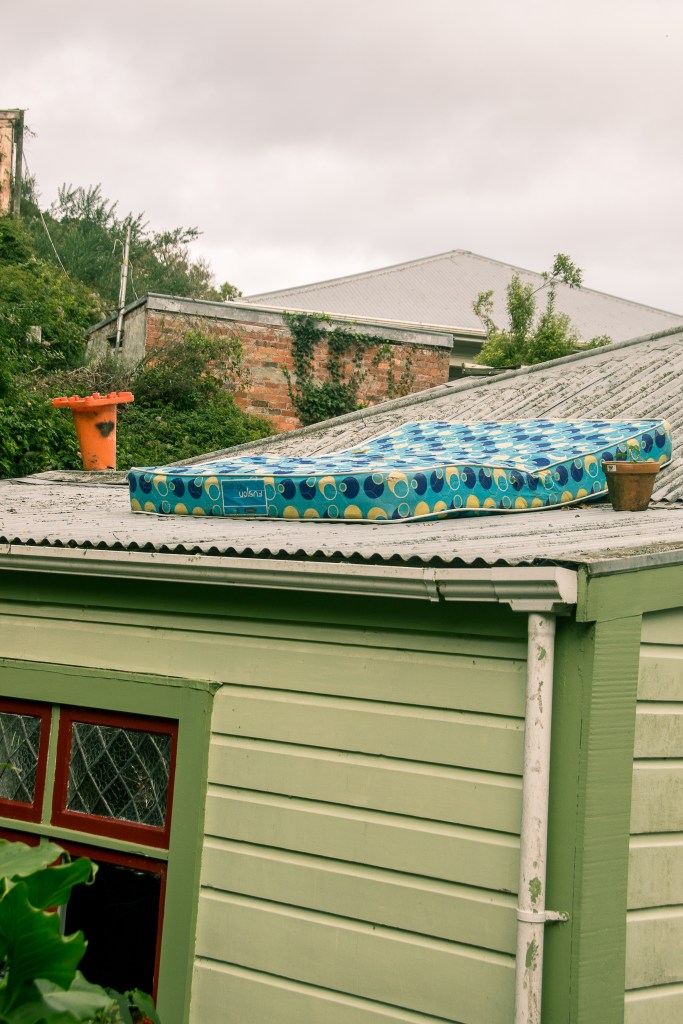
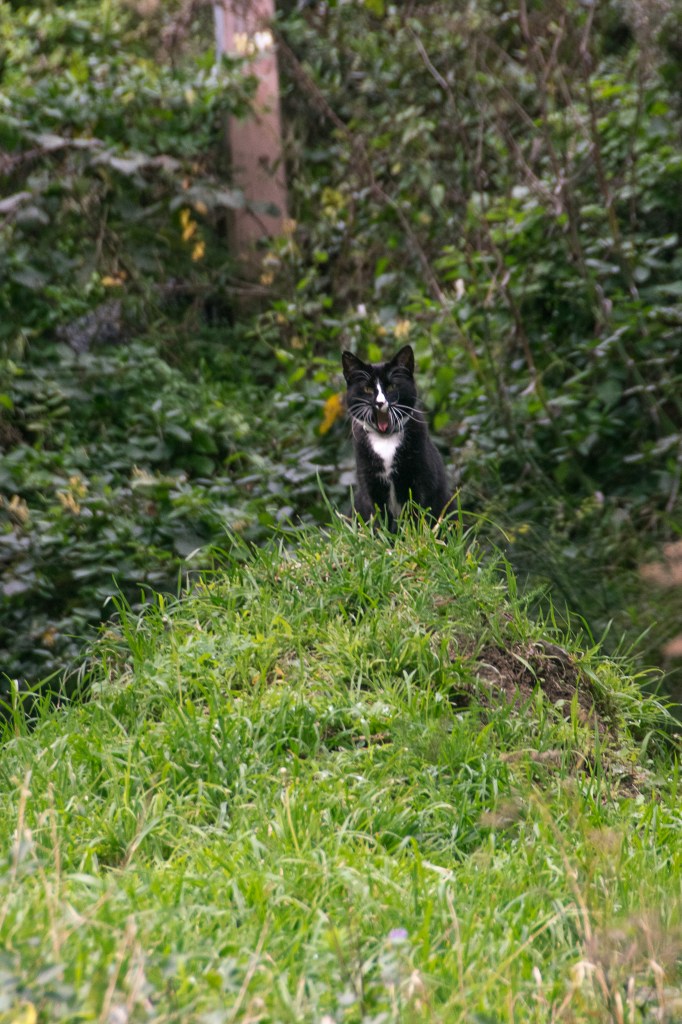
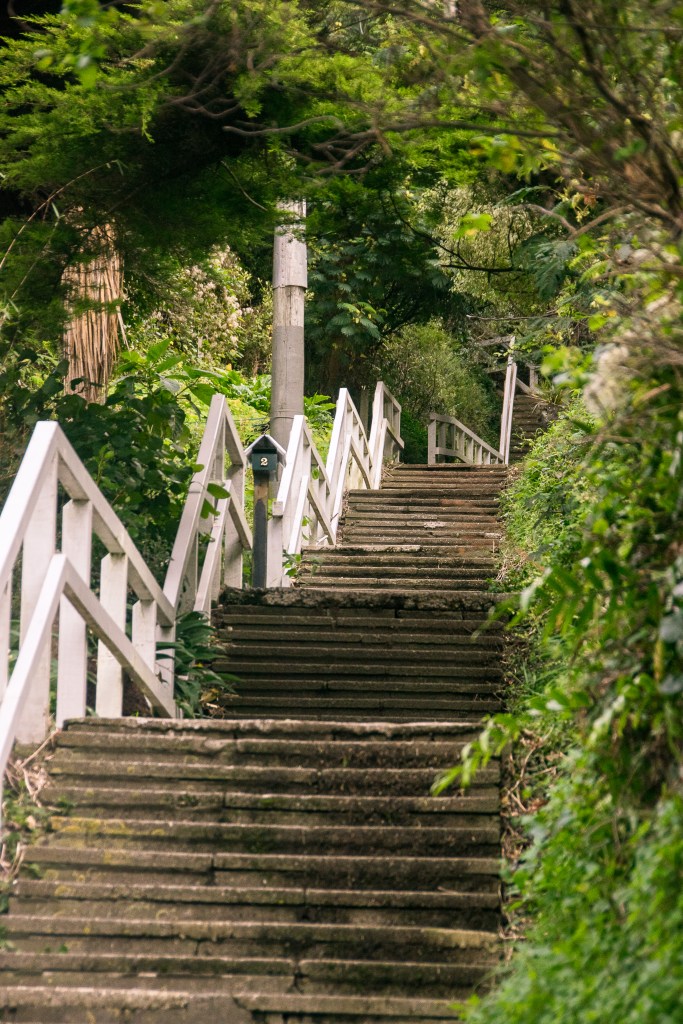
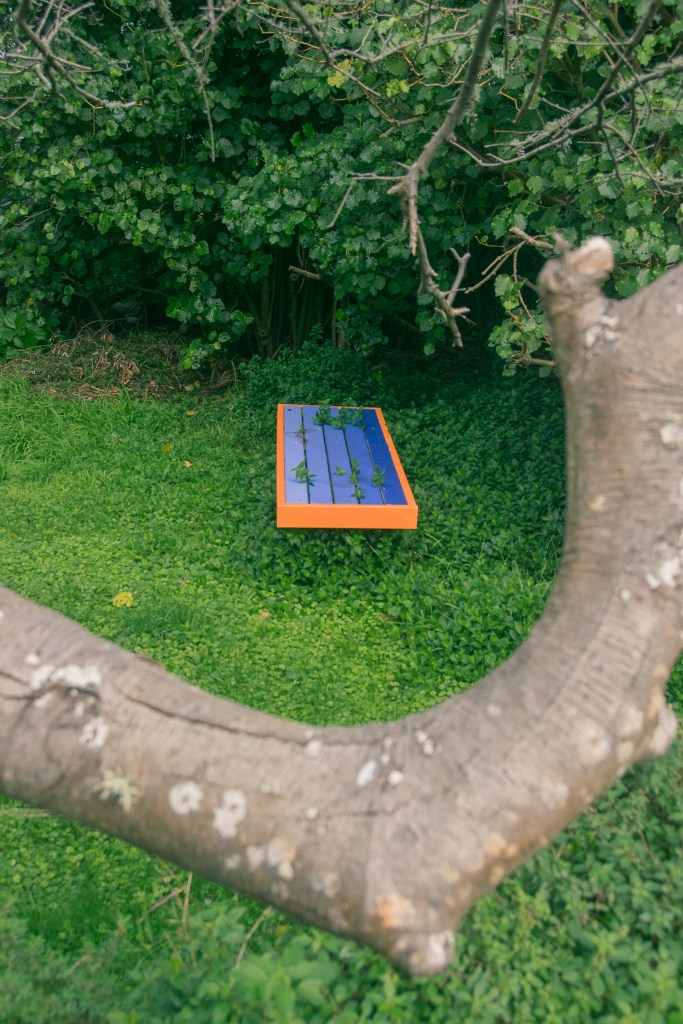
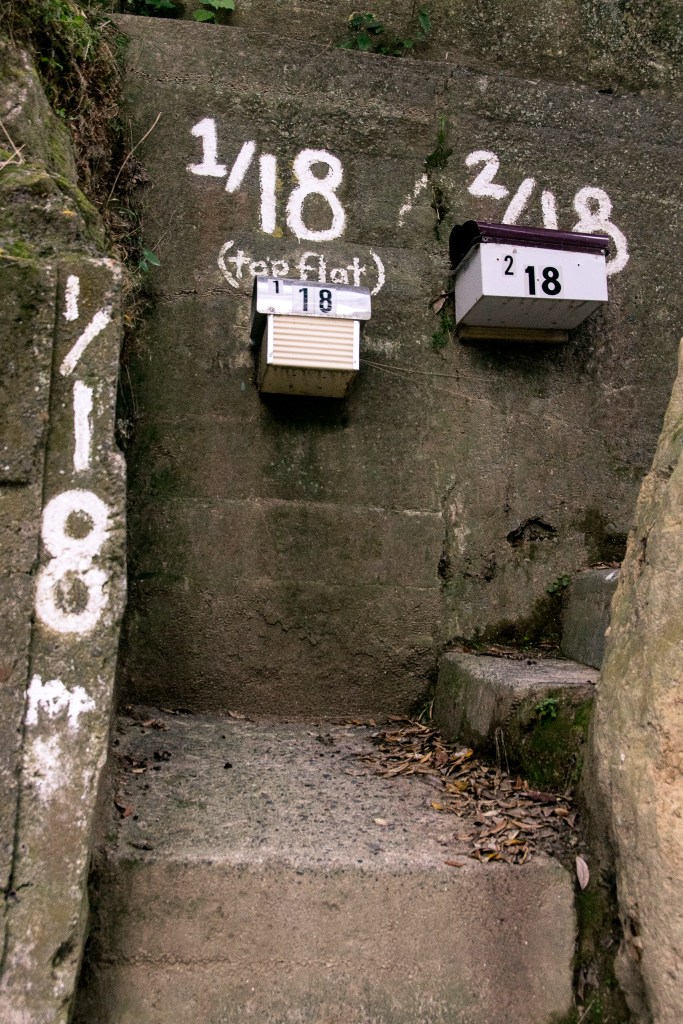
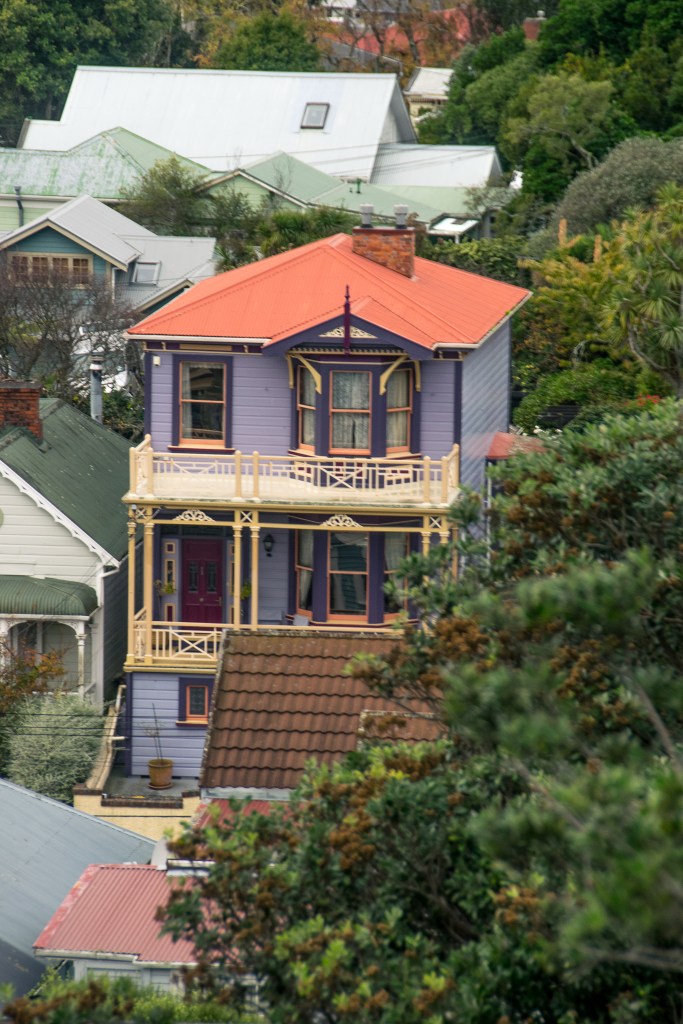
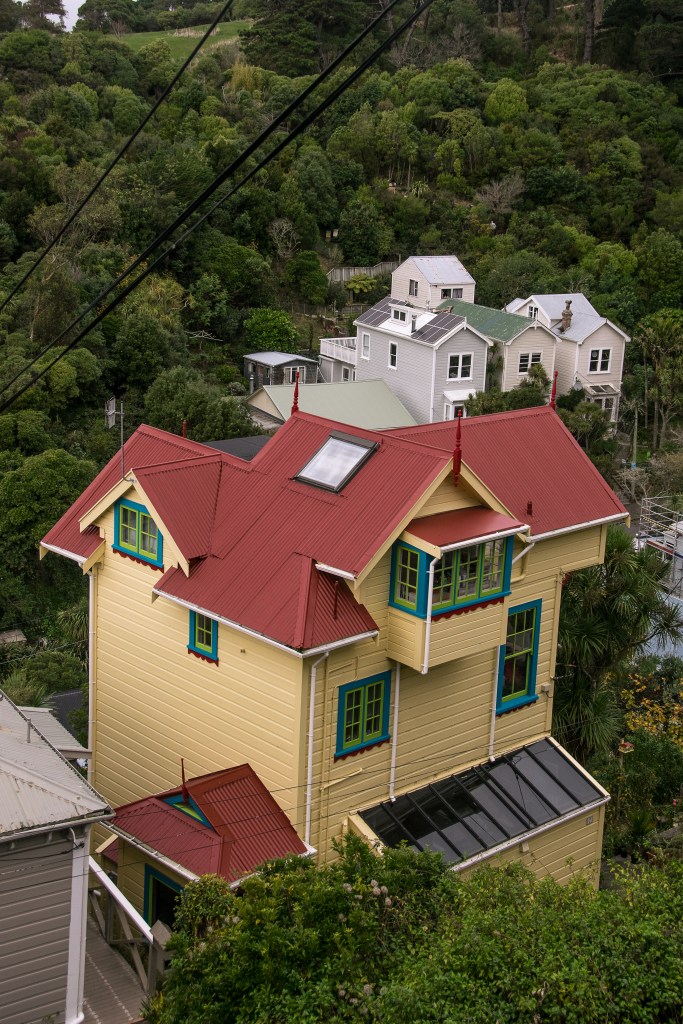
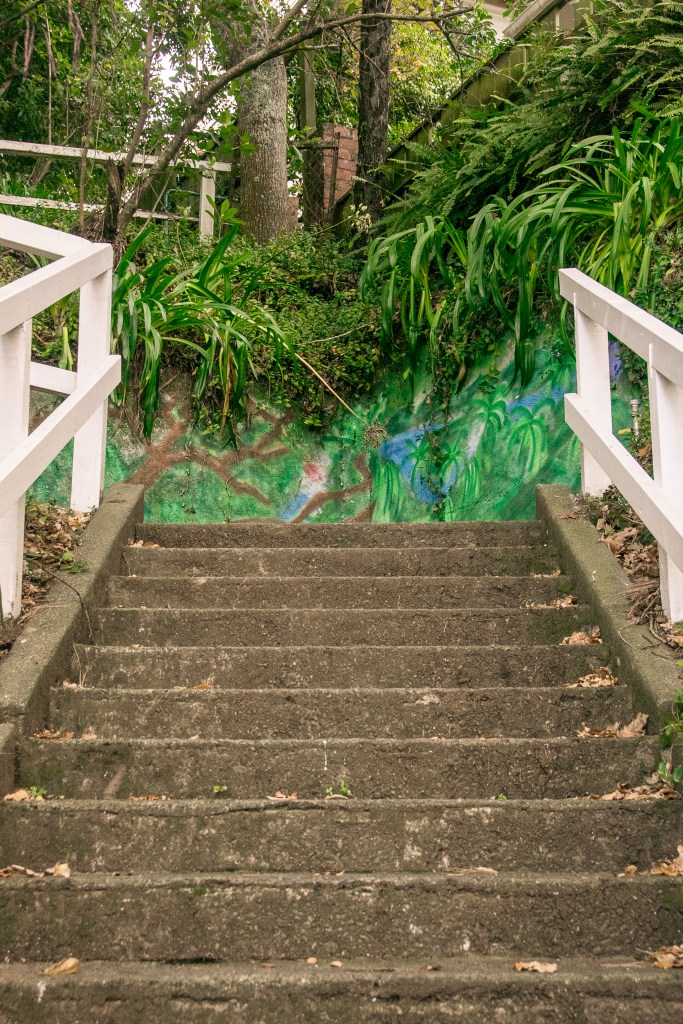
I wanted to create a piece of work that embodied the accessibility issues of pedestrian accessways in Aro Valley. Specifically the focus was on mobility and light. The lighting of these accessways is minimal and often makes people unsafe, with personal experiences of unsafe interactions at night. Also So much of this suburb is hidden from people that have mobility issues, this restricts both the interesting and quirky bits of the suburb I love, it also restricts housing for a notoriously marginalized group.
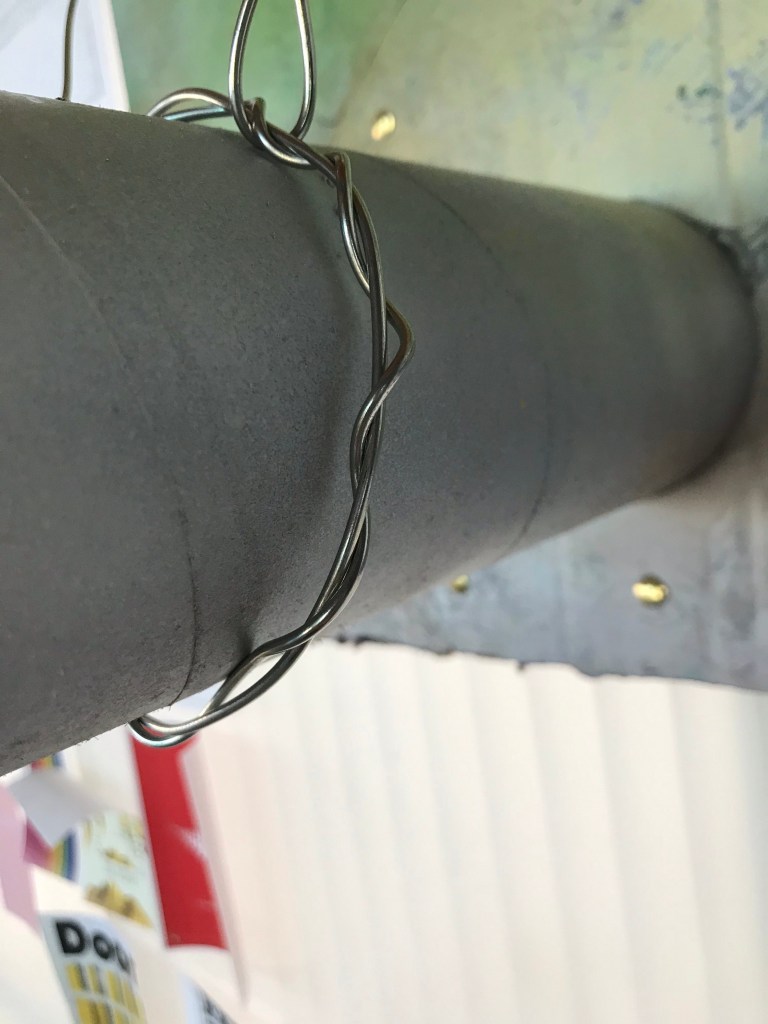
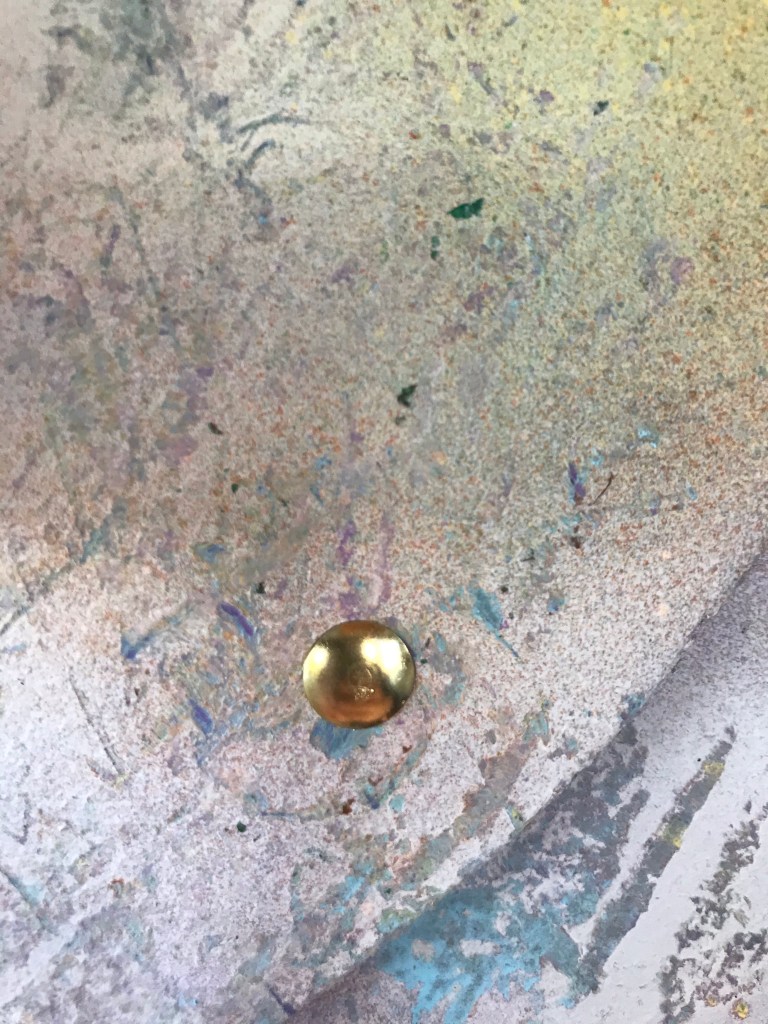
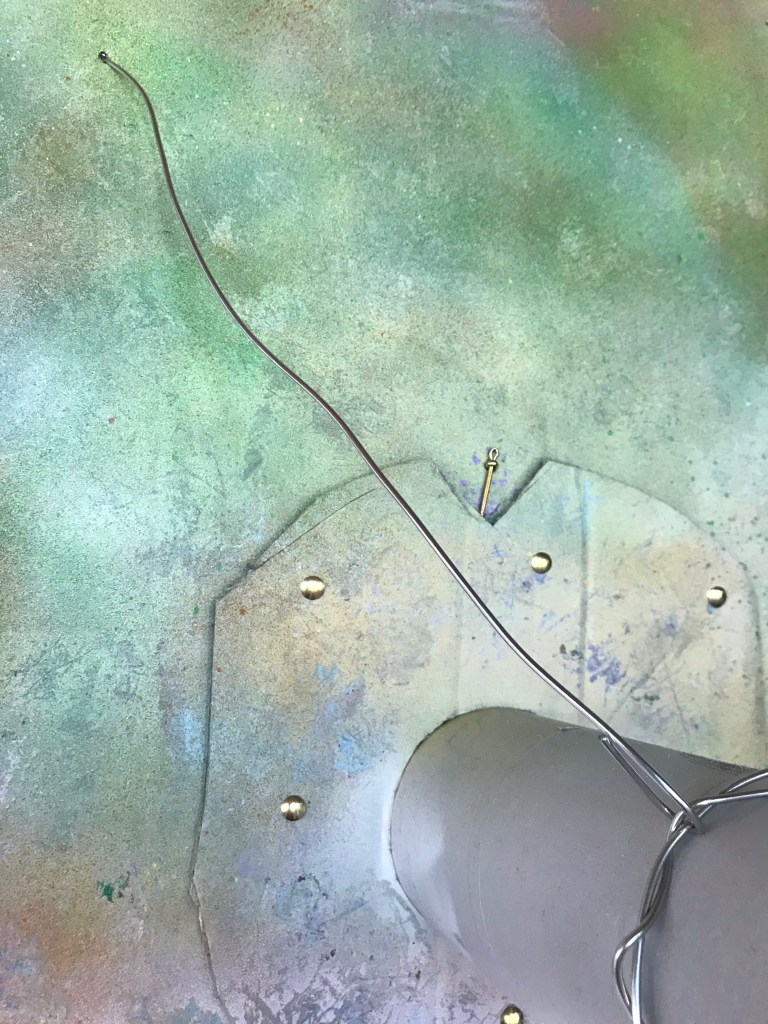
The idea was to create a ‘viewfinder’ like old film viewers. I would take pictures of the interesting bits and pieces I found in the accessways. Then I would place the viewfinder in a difficult to reach spot without having to climb, and use a light to view the images. This embodies the experience and difficulties people face everyday to just to move and view our city in a way most people don’t consider.


Reflective statement
Throughout the Communication for Maker’s course I have found myself again and again asked to reiterate and hold up my own beliefs, and in doing so harden my resolve to continue to push and explore a more radical ways of thinking.
It is worth noting that coming into the course, I already have had some form of academic discussion around the topics we discussed within different contexts. Especially ethics in both a anthropology and science environment. So, while we have had a very surface look at topics such as disability or treaty politics it has been good to return to the beginning of this learning, and reaffirm my position based on where we all begin.
My wish is continue pursuing and deepening this knowledge and become more articulate with this information to help create a more progressive and equitable society. It also brings to light the lack of collaboration I have had within making spaces in particular cultural settings. I would like to be a part of and in conversation with the larger cultural conversation in Aotearoa. Making has the ability to bring to light and deal with social issues I hold dear, and finding more eloquent and aesthetic ways of producing these ideas gives me creative energy to move forward with.
In terms of what I would like to stop doing in my work is using excuses of time and scope to explore the directions more fully that I was taking, especially towards my final project. I had the chance to go out and engage with the concerned communities, in particular reach out to disabled organisations for comment and chose not to. Nor did I use connections within the Council to comment on bylaw around pedestrian only access. Using the excuse of this being a first-year course limited the scope of this project, and as a result could now be continued in the future. Embodying some of the knowledge talked about in the course around Kaupapa and Tikanga would put my money where my mouth is, so to speak.
Overall, I found the course in interesting provocation into thinking and producing work that has a more critical eye on the world around us rather than my own internal experiences.
 Sasha's WorkBlog